
Short answer: if a job asks you to deposit your own money before you can withdraw your earnings, it’s a scam — and the fact that it paid you $20 last week is part of the design, not evidence against it. The FTC calls these task scams, and reports went from about 5,000 in all of 2023 to about 20,000 in the first half of 2024 alone.
How it starts
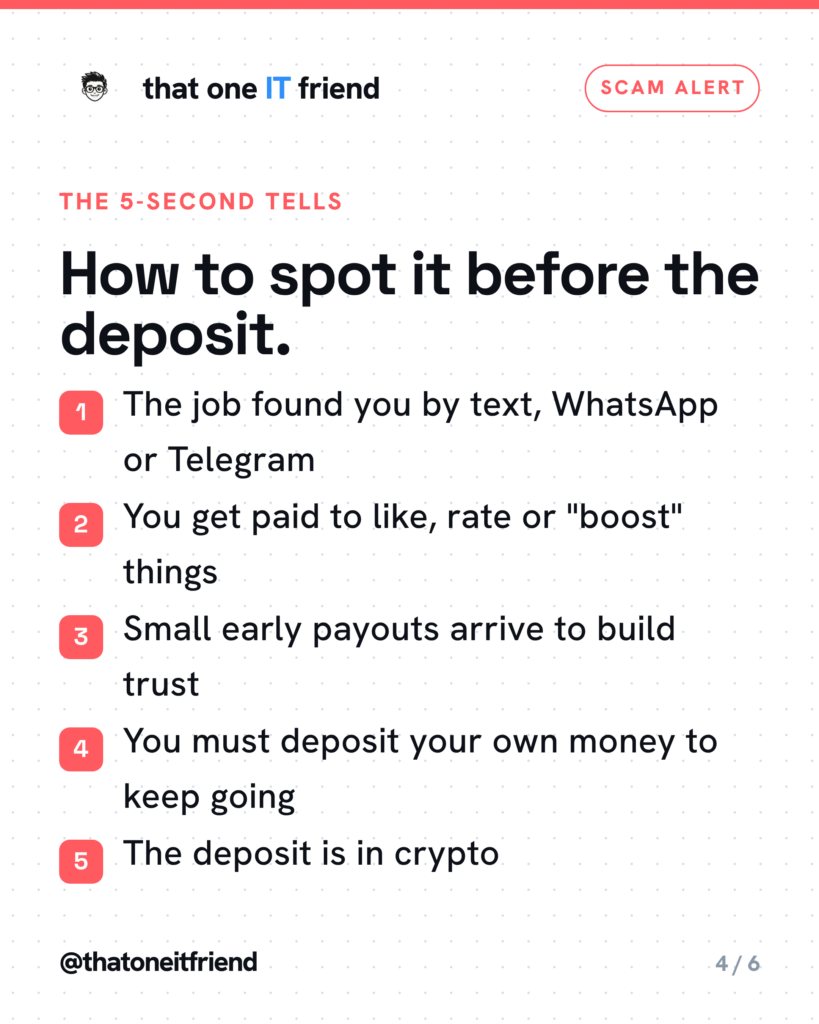
An unexpected message lands on your phone — a text, or WhatsApp, or Telegram. It mentions money without mentioning a job: a daily rate, a commission percentage, a “remote position.” The FTC’s line on this is short and useful: real employers will never contact you that way.
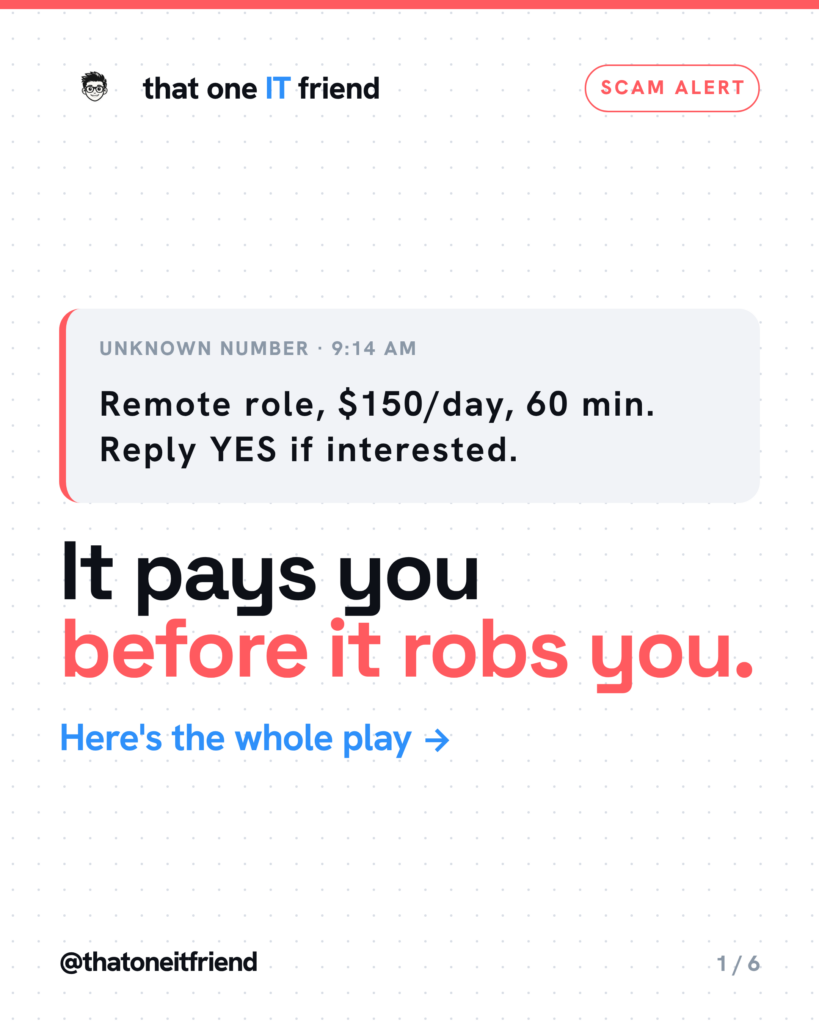
There’s a newer version worth knowing about, because it defeats the advice most people already follow. An April 2026 FTC alert describes fake recruiters who don’t ask you to click anything: “instead of asking you to click a link, they’ll ask you to reply with ‘YES’ or ‘INTERESTED.’ Don’t do this, no matter how ‘professional’ the graphics or message looks and sounds.” You’ve trained yourself not to tap links. This asks for a word.
The work is real. The money on screen is not.
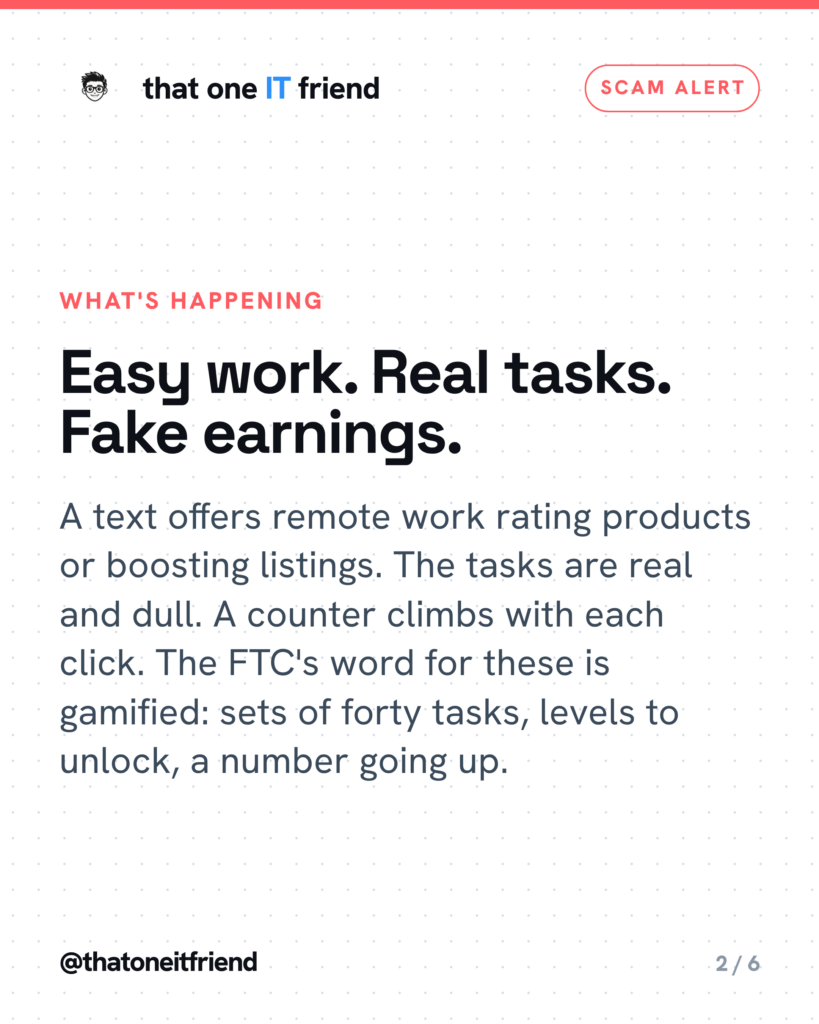
You land on an app or website and start doing genuinely simple things: liking videos, rating product images, “product boosting,” “optimization.” The FBI describes it as “‘optimizing’ a service by repeatedly clicking a button.” A counter goes up. The FTC’s data spotlight notes tasks “are often assigned in sets of forty, with the promise of leveling up once you complete your set.”
Read that again, because it isn’t a payroll system. It’s a game loop. Sets, levels, a rising number, a progress bar. The reward schedule is the product.
Why the first payment is the trap
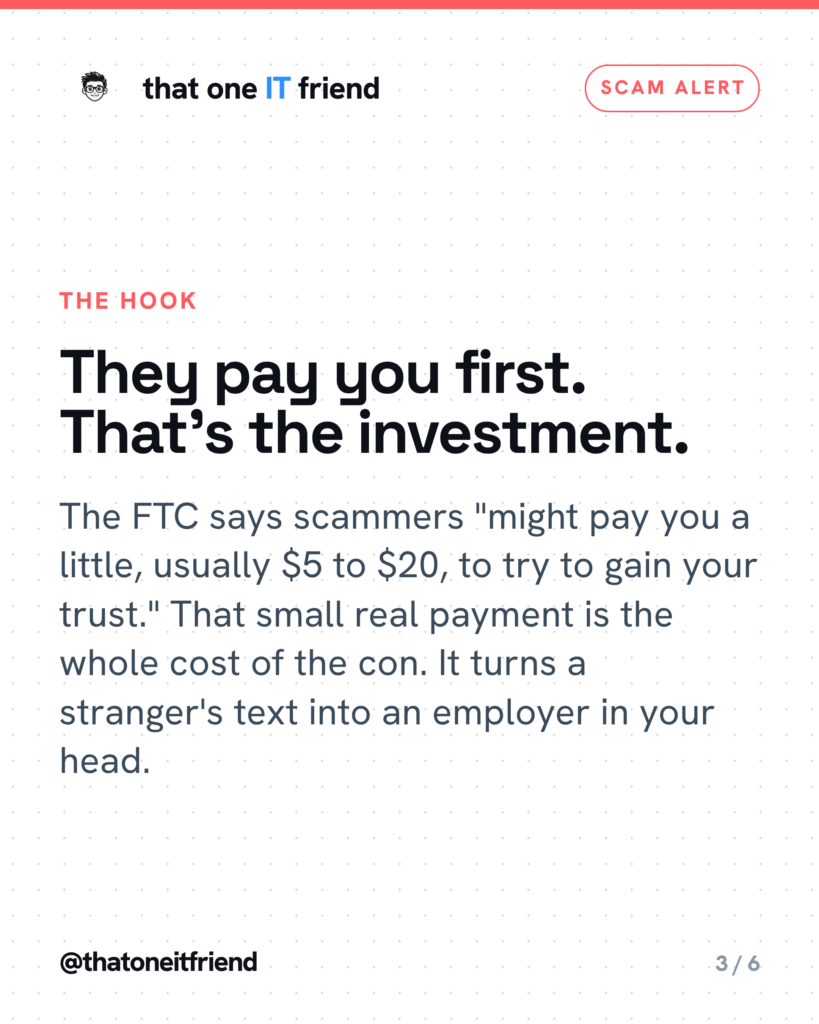
This is the part that makes task scams different from almost everything else, and it’s why people who consider themselves hard to fool get caught. The scammer pays you. The FTC states it directly: they “might pay you a little — usually $5 to $20 — to try to gain your trust.”
Twenty dollars is the entire capital outlay of the con. It converts an anonymous text into an employer, and it converts you from someone being asked for money by a stranger into an employee unlocking your own wages. By the time the deposit comes up, you’ve done hours of clicking and you’re looking at a balance you feel you earned. Walking away doesn’t feel like avoiding a scam. It feels like quitting a job and forfeiting your pay.
The turn
To unlock the next set of tasks, or to withdraw the balance on your screen, you have to deposit your own money. Usually crypto. The FBI calls it “a confusing compensation structure that requires victims to make cryptocurrency payments in order to earn more money or ‘unlock’ work,” and notes the platform is “a fake interface, which shows victims are earning money, though none of it is available to them to cash out.”
If you deposit, the withdrawal still doesn’t clear. A fee appears. The New York Attorney General’s January 2025 case against one of these operations documented invented charges with names like a “credit score improvement fee” and a “blockchain verification fee,” each requiring another deposit. One New Yorker lost more than $100,000. The AG froze $2.2 million in crypto.
What to do instead
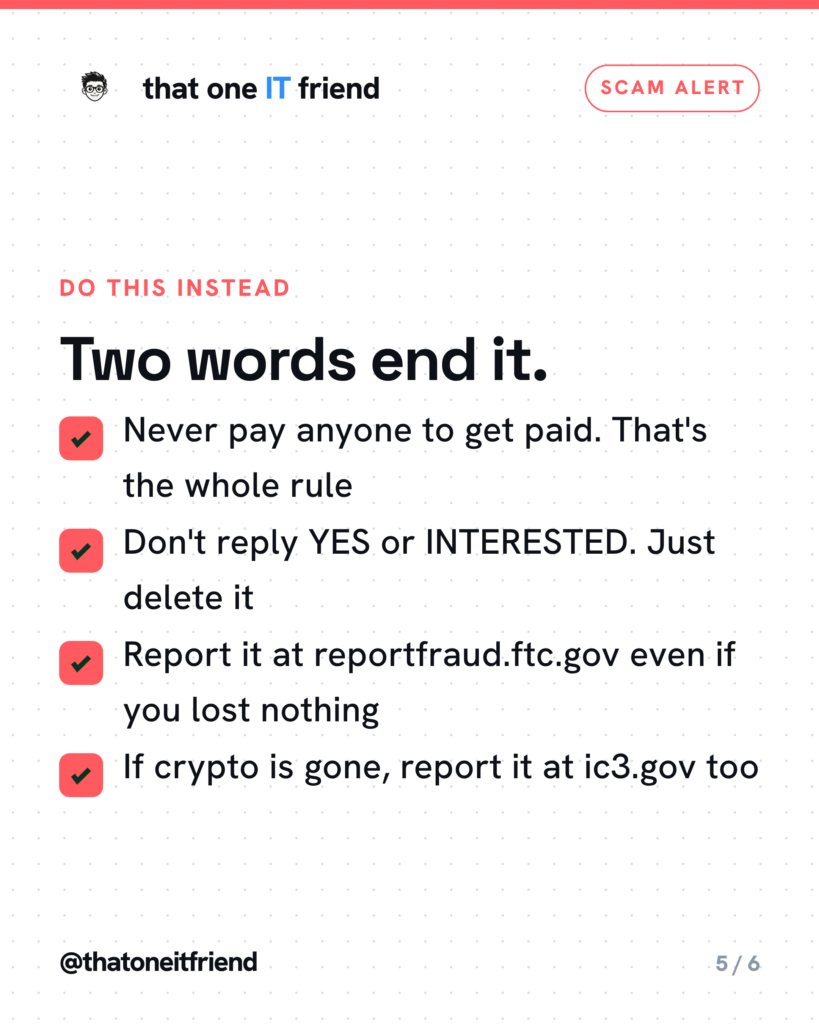
- Ignore unexpected job offers that arrive by text, WhatsApp or Telegram. Don’t reply, not even to decline.
- Never pay anyone to get paid, or to get a job. The FTC calls this “a sure sign of a scam,” and it has no honest exceptions.
- Report it at reportfraud.ftc.gov even if you lost nothing. Reports are how these get shut down.
- If you sent crypto, report it at ic3.gov with the transaction details, and ignore anyone who contacts you afterward offering to recover it. The FBI warns specifically about recovery scams targeting people who already lost money.
The one rule to remember
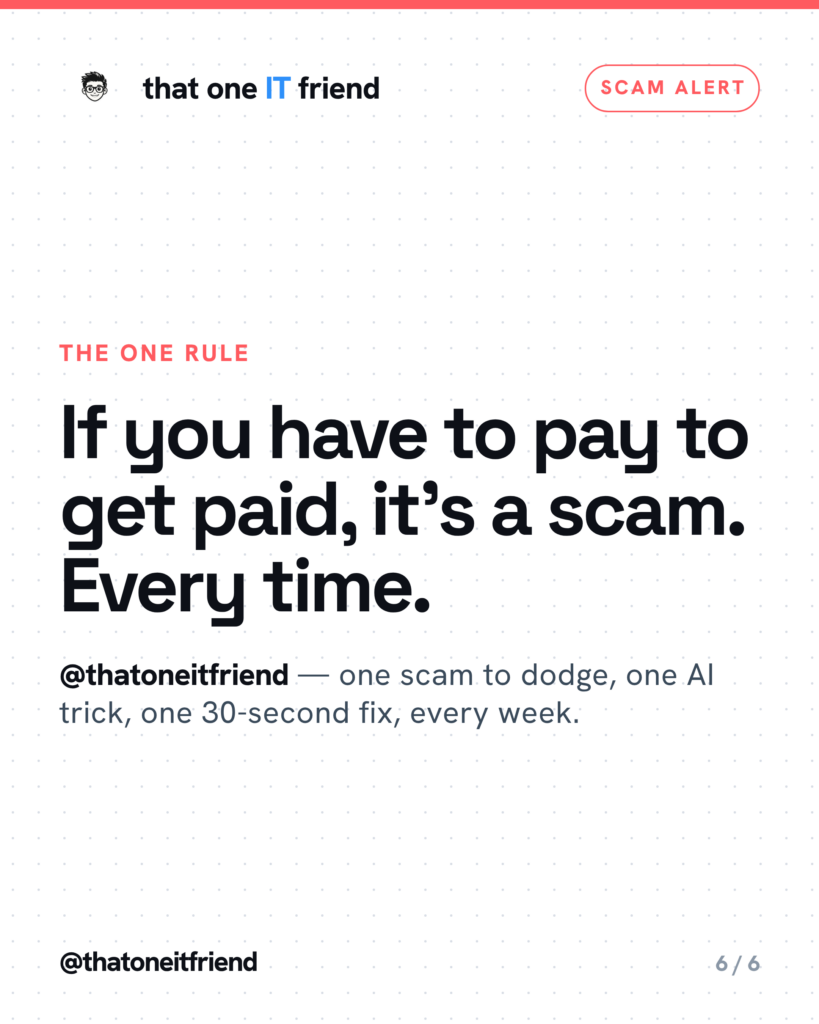
If you have to pay to get paid, it’s a scam. Every time. Not a deposit, not a training fee, not a verification fee, not a fee to unlock the next set. No legitimate employer has ever required you to fund your own wages.
Frequently asked questions
They paid me the first time, so how is it a scam?
That payment is the scam’s cost of doing business. The FTC says scammers “might pay you a little — usually $5 to $20 — to try to gain your trust.” A real employer’s first payment is a paycheck. A task scam’s first payment is bait: spending $20 to take $2,000. Getting paid once proves they wanted your trust, not that the job is real.
The app says I've earned $1,400. Isn't that mine?
No. It’s a number in an interface the scammer controls, not a balance anywhere. The FBI describes it as a fake interface showing earnings that are never available to cash out, and the FTC puts it bluntly: no matter what the system says you’ve earned, you didn’t. Depositing to release it just loses the deposit too.
Some real jobs have startup costs. Why is a deposit automatically a scam?
Because the ask here is to pay in order to receive money you supposedly already earned. That’s the line. The FTC: “Never pay anyone to get paid, or to get a job. That’s a sure sign of a scam.” The FBI: never send money to an alleged employer.
I already deposited. What now?
Report it at reportfraud.ftc.gov and, if crypto was involved, at ic3.gov with transaction details. Recovery isn’t guaranteed but it does happen — the New York AG froze $2.2 million taken in exactly this scheme. Then protect yourself from the second hit: the FBI warns not to pay anyone claiming they can recover lost crypto. People who lost money once get targeted again.
Every week I break down one scam to dodge, one genuinely useful AI trick, and one 30-second tech fix, in plain English. Follow @thatoneitfriend on Instagram, TikTok, and Facebook, or get the weekly rundown by email at thatoneitfriend.com.